
Keeping track of how research from a scholarly article or a policy-focused publication spreads into policy documents can be pretty tricky, especially as it moves from the original source to secondary, tertiary, and even further citations!
A visualisation like this one below can help. It begins with a scholarly article, which has been cited in 2 policy documents. These are the primary citations. Each of those policy documents is cited by a further 3 policy documents. These documents contain the secondary citations (also referred to as second-order citations).
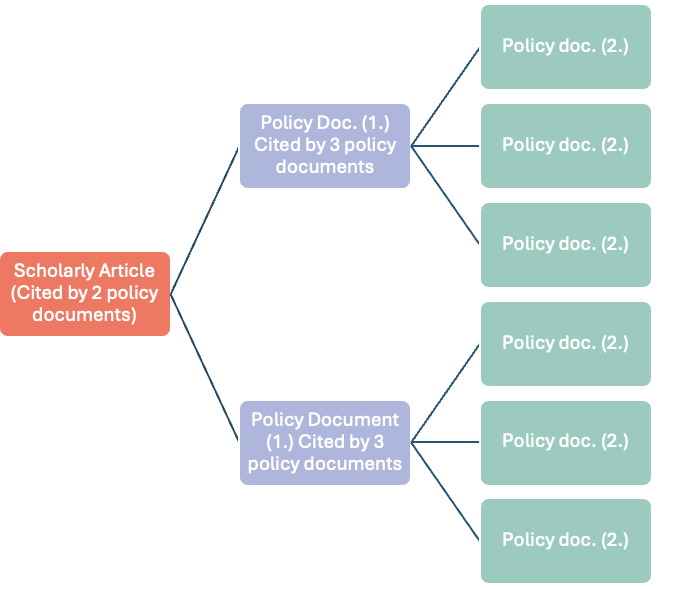
How to go from primary to secondary policy citations
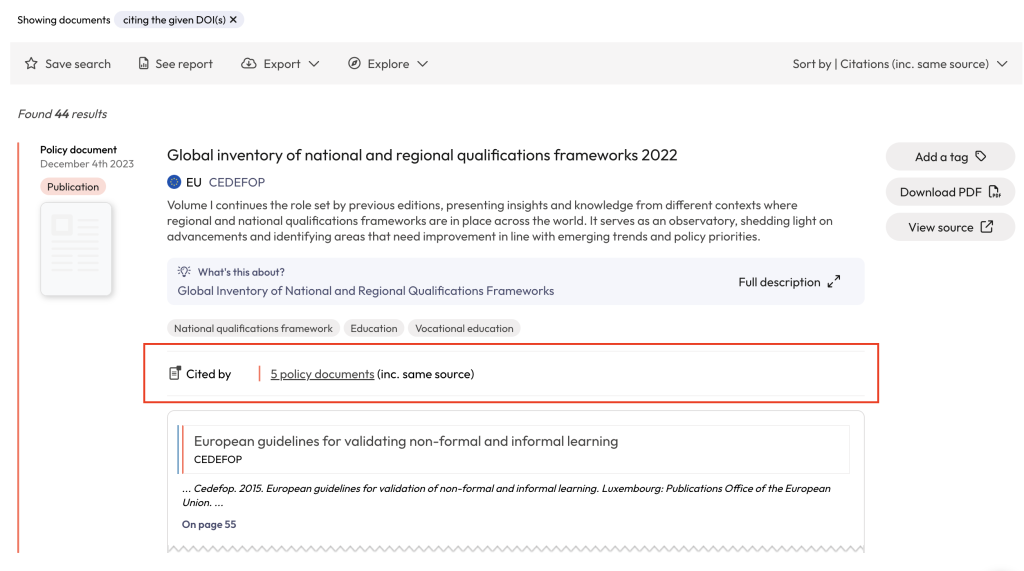
This example begins with a scholarly article search result. It has been cited by 5 policy documents. Clicking on the ‘5’ will take you to the list of 5 policy documents that cite the scholarly article. These documents contain primary citations.
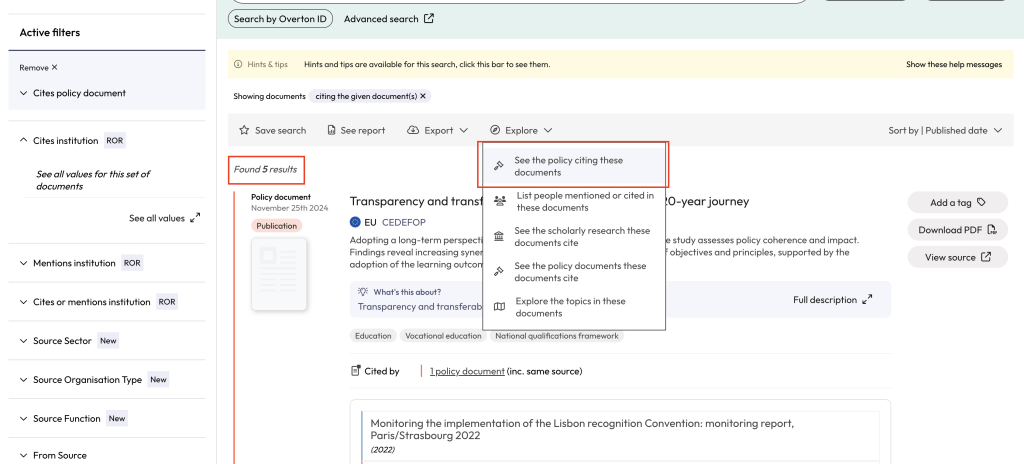
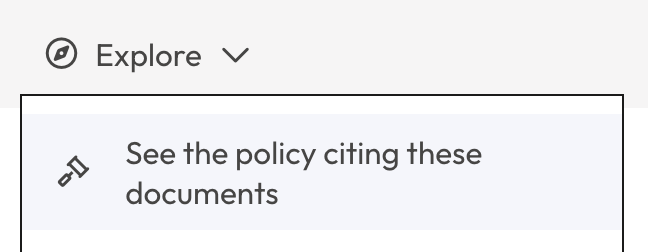
In the grey action bar above the 5 policy document results, there is an option called ‘Explore’. From ‘Explore’ you can select “see the policy citing these documents” to see if the original 5 policy documents have been further cited.
In this case, 19 other policy documents cite the original 6 policy documents. These 19 documents contain the secondary citations.
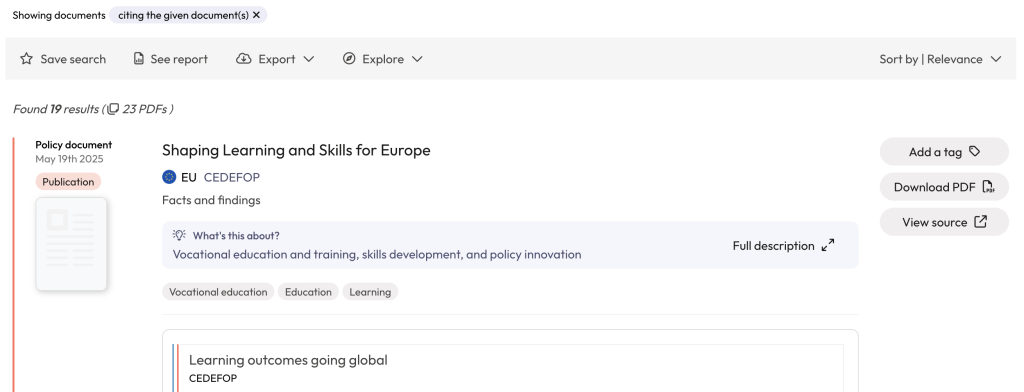
Users can continue using ‘Explore’ and “see the policy citing these documents” function. However, bear in mind that as you go further down the citation chain, the likelihood of having a direct impact could lessen.
What about the cascading impact of policy-focused publications?
The same principle and steps would apply. The only difference is in the starting point. Instead of starting with a scholarly article, you’d start with a policy document.
The workflow below shows an example of chasing evidence of impact for a policy-focused publication.
1. Find the document you want to follow citations for.
This example uses “The State of the World’s Midwifery 2021 from the UNFPA”. It has been cited by 95 other policy documents not from the UNFPA.

2. Click on the link for the number of citing policy documents to see these results.

3. A. Your results will be first order citations for the original document.
B. Click on Explore and then “See the policy citing these documents” to find the second order citations, so the policy documents which cite this set of results.

4. Your results will be for the ‘second order’ citations – so the policy documents that cite the documents that cite original document “The State of the World’s Midwifery 2021 from the UNFPA.”
